Personal Project
Weather Monitoring System
Project Duration
2012–2023
Role and Contribution
Project Manager and Lead Developer (Approx. 90% Contribution)
Technologies and Skills Applied
-
Embedded Hardware Design (OrCAD: Schematic Design, PCB Layout)
-
Embedded Software Development (Arduino, ATmega, STM32 in C)
-
Web Front-End Development and UI Design (HTML, CSS, JavaScript)
-
Web Back-End Development (PHP, Node.js, MariaDB/MySQL)
-
Server and Network Management (Linux)
-
iOS App Development and UI Design (Swift)
-
Android App Development and UI Design (Java, Kotlin)
-
UI/UX Design (Adobe Illustrator)
-
Mechanical Design / CAD (SolidWorks, SketchUp)
-
Hardware Integration and Electrical Installation
Phase 1 (2012–2014) – Weather & Indoor Climate Monitoring System
Introduction
This extensive project, spanning from my high school years through my graduate studies, involved developing versatile weather monitoring systems for outdoor, agricultural, and residential environments.
During the first phase, I developed an IoT-enabled outdoor weather station alongside an indoor climate monitoring system.
Weather Monitoring System
I built the system around an ATmega-based microcontroller (Arduino)—a significant technical challenge at the time, as this technology was not yet widely adopted in Korea. To ensure accurate environmental readings, I designed and fabricated a custom Stevenson screen to house the temperature, humidity, and atmospheric pressure sensors.
I engineered the power control module for versatility in remote locations, integrating three distinct power inputs: standard DC, solar charging, and Power-over-Ethernet (PoE).
After installing the system at Daegu Science High School, it performed continuous, real-time weather monitoring over an extended period. It successfully captured microclimate data during a wildfire on Apsan Mountain, verifying the system’s effectiveness for specialized environmental monitoring.
Furthermore, I deployed these devices in greenhouses and livestock sheds, enabling owners to remotely monitor their properties and take preventive action during extreme summer and winter weather conditions.
Recognition: In recognition of its innovation, the system was awarded the Presidential Award (Grand Prize) at the 59th National Science Fair of Korea, presented by President Geun-hye Park.
Additionally, the project secured the Grand Prize at the 5th ISEF-K competition, presented by the Director of the National Science Museum of Korea.

Wi-Fi Weather Monitoring System for Outdoor and Agricultural Environments (Jun 2013)

User Setting CD for Setting Up the Wi-Fi Weather Monitoring System (July 2013)

Verification of the Developed Weather Monitoring System at the Korea Meteorological Administration (KMA) in Daegu (Jun 2013)
%20%EC%A0%84%EA%B5%AD%20%EC%A0%84%EB%9E%8C%ED%9A%8C%20-%20%EB%8C%80%ED%86%B5%EB%A0%B9.jpg)
Presidential Award (Grand Prize) – 59th National Science Fair of Korea, presented by President Geun-hye Park (Sep 2013)
%20ISEF-K%20-%20%EA%B3%BC%ED%95%99%EA%B4%80%EC%9E%A5.jpg)
Grand Prize – 5th ISEF-K Competition, presented by the Director of the National Science Museum of Korea (Jan 2014)
Indoor Climate Monitoring System
Following the national success of the weather monitoring system, I developed an advanced indoor climate monitor designed to alert users to the health risks of indoor air pollution.
The device, named “Mideumi Weather Capsule,” tracked standard meteorological parameters alongside particulate matter and gas concentrations. Data was transmitted to a web server and stored in a MySQL database via PHP. A companion Android application (developed in Java) allowed users to monitor real-time indoor conditions and receive immediate warning notifications during critical air quality events.
Recognition: In recognition of its innovation, the system was awarded the Third Place Award at the Intel International Science and Engineering Fair (Intel ISEF) 2014.


Indoor Climate Monitoring System “Mideumi Weather Capsule” (May 2014)


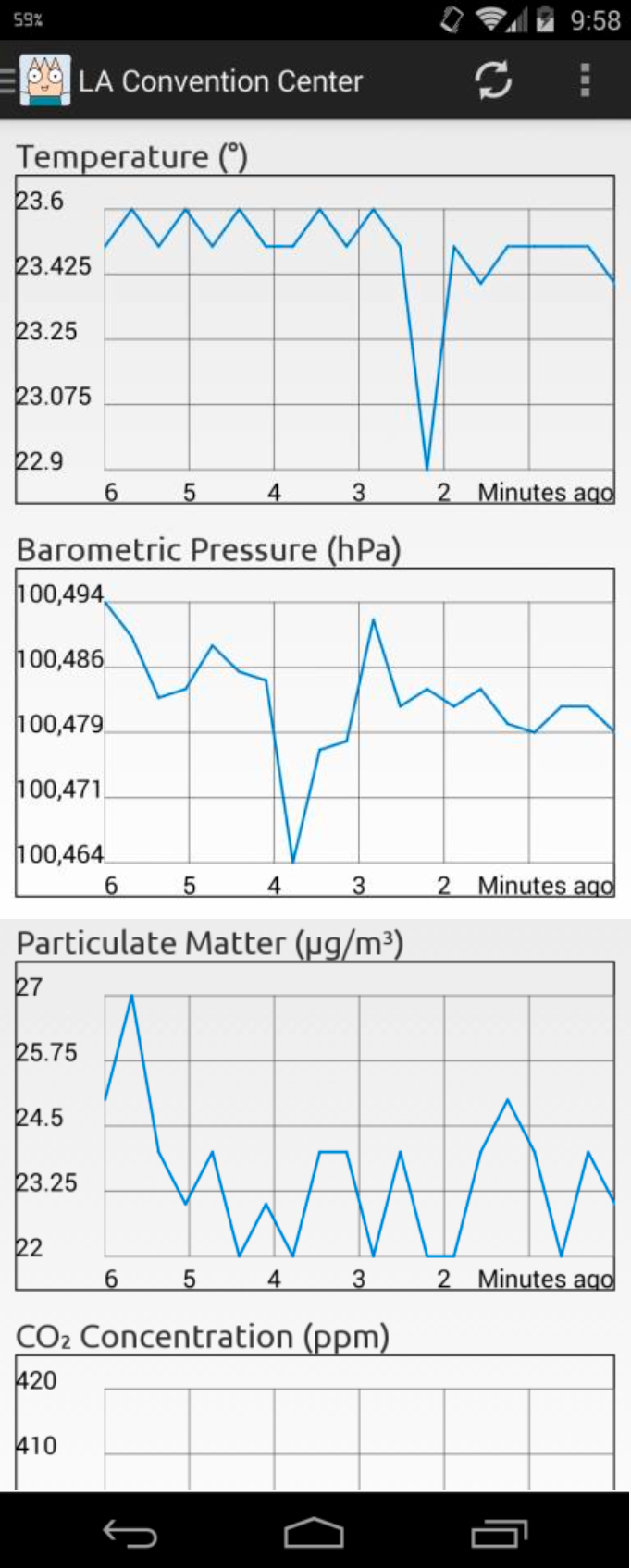
Design and Development of the Companion Android App for “Mideumi Weather Capsule” with Java (May 2014)

Presentation of “Mideumi Weather Capsule” at Intel ISEF 2014, Los Angeles, USA (May 2014)

Hobby Project “Mideumi Weather Walker” – Microclimate Monitoring Leather Shoes (Jul 2015)

Third Place Award – Intel International Science and Engineering Fair (Intel ISEF) 2014 (May 2014)
Phase 2 (2015–2019) – POSTECH Weather Station V1
Introduction
In the second phase of the project, an official weather station for POSTECH was developed. An ATmega-based custom PCB was designed and implemented to measure weather conditions and wirelessly transmit the data to a base station. The base station was connected to a MySQL database via a web server, initially implemented using PHP, enabling various graphical user interfaces to access the sensor data.
Implementation
As user interfaces, a public website, Android and iOS mobile applications, and a digital display board installed at the university’s main gate were developed. The website and backend server were initially designed and implemented using PHP, and later upgraded to Node.js. The Android application was first developed in Java and subsequently migrated to Kotlin, while the iOS application was developed using Swift.

POSTECH Weather Station’s Ground Monitoring Unit (Jul 2017)

POSTECH Weather Station in Operation on the Digital Display Board at POSTECH Main Gate (Jun 2018)

Promotional Poster for the POSTECH Weather Station (Feb 2018)


Android Application (V2.10, Kotlin) for POSTECH Weather Station (Feb 2019)
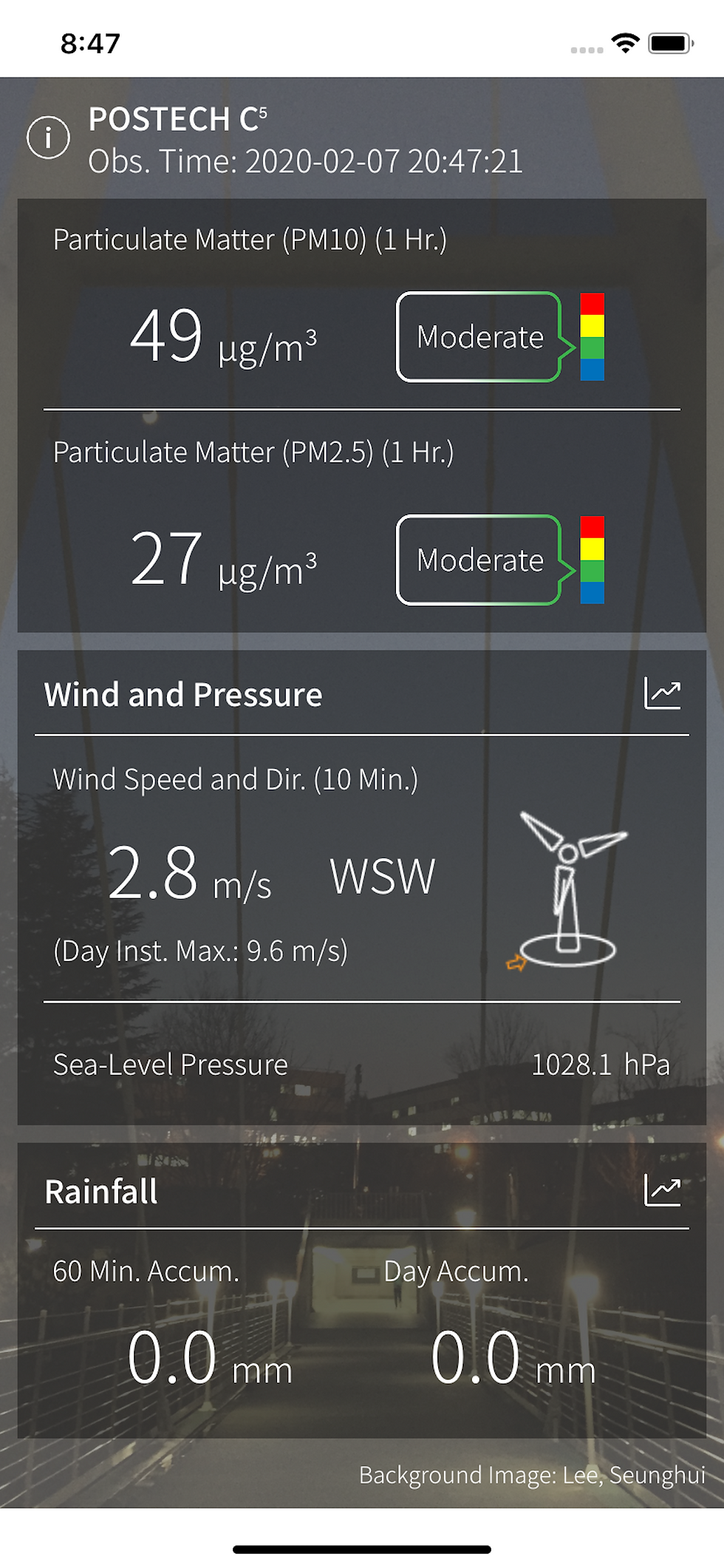

iOS Application (V2.10, Swift) for POSTECH Weather Station (Feb 2019)
Shown in the Media
-0008.png)
-0007.png)
POSTECH Weather Station Featured on Korean Public Broadcaster KBS (Apr 2018)
Phase 3 (2019–2023) – POSTECH Weather Station V2
For the second version of the POSTECH weather station, the hardware architecture, including the custom PCB, was upgraded to ensure long-term durability for outdoor operation. The system is powered via DC input or Power over Ethernet (PoE) and utilises an STM32F4 microcontroller to measure sensor data and transmit it to the web server database using the LwIP protocol stack.

POSTECH Weather Station V2 (May 2023)


Circuit board of POSTECH Weather Station V2 (Jan 2023)